
Amylyx's GLP-1 Blocker Bet Yields Positive Late-Stage Data
Amylyx Pharmaceuticals announced positive late-stage trial results for avexitide, a potential first-in-class treatment for post-bariatric hypoglycemia. The drug reduced serious-to-severe hypoglycemic events by 55% versus placebo and appeared safe. Amylyx intends to file for FDA approval before year-end, marking a comeback after withdrawing its ALS drug in 2024.
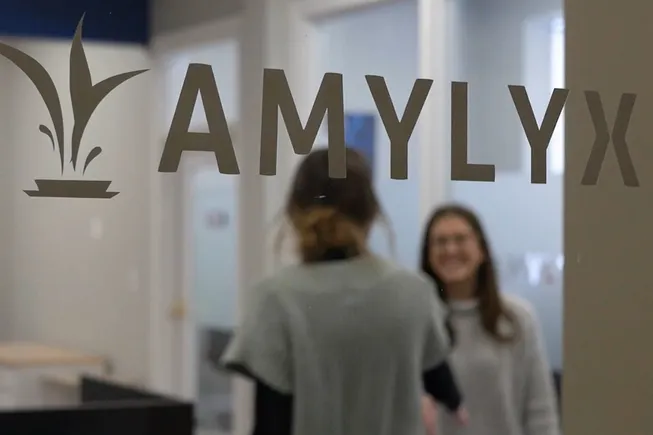
A Boston-area drugmaker that once traded at lofty heights staged a partial comeback on Tuesday, unveiling positive results from a late-stage clinical trial of a potentially first-of-its-kind therapy for dangerously low blood sugar levels that can occur after bariatric surgery.
Amylyx Pharmaceuticals said its candidate, avexitide, met the study's primary endpoint, achieving a 55% reduction in serious-to-severe hypoglycemic events compared with placebo. Such episodes deprive the brain of glucose, its primary fuel, leading to confusion, dizziness, slurred speech, and loss of coordination. In more severe cases, patients may faint, experience seizures, or fall into a coma.
According to Amylyx, the medicine also appeared safe. Researchers classified the majority of adverse events as mild or moderate, with the most common being diarrhea and injection-site bruising or redness. Amylyx now plans to formally submit a new drug application to the Food and Drug Administration before the end of the year.
“What we heard very consistently from endocrinologists and people with [post-bariatric hypoglycemia] is that every one of these events is a medical emergency. Preventing even a single event matters,” Justin Klee, co-founder and co-CEO of Amylyx, said in an interview.
Klee added that when the Amylyx team informed the medical experts on the trial's steering committee of the findings, they were “over the moon.” Currently, no approved drugs exist for post-bariatric hypoglycemia, a condition that, according to research cited by the Cleveland Clinic Journal of Medicine, affects roughly one-tenth to one-third of patients who undergo the procedure.
“This is a totally debilitating disease for people who get it,” said Joshua Cohen, the other co-founder and co-CEO of Amylyx, who described the new results as a “home run” and far above most expectations.
Cohen and Klee declined to say whether Amylyx will meet with FDA staff before filing for approval. However, they noted that the agency has already granted avexitide a special status intended to expedite the development and review of certain treatments for serious or life-threatening conditions.

Avexitide acts on the same GLP-1 receptors as the blockbuster class of diabetes and weight-loss medications sold by Eli Lilly and Novo Nordisk. However, unlike those drugs, avexitide blocks the receptors to decrease insulin production and stabilize blood sugar levels.
Amylyx acquired the drug for $35 million through the 2024 bankruptcy proceedings of Eiger BioPharmaceuticals. According to Klee and Cohen, the purchase made strategic sense for several reasons, including that Eiger had already run several mid-stage trials focused on either post-bariatric hypoglycemia or “congenital hyperinsulinism,” a genetic disorder in which the pancreas produces too much insulin.
The duo therefore bet that Amylyx would need only one positive late-stage experiment to submit a marketing application. They said their team has been assembling the application throughout this year, and commercial launch preparations are underway.
In a note to clients Monday, analysts at Mizuho Securities estimated that risk-adjusted revenue from avexitide could reach $1.3 billion by 2040.
Joseph Thome, an analyst at TD Cowen, has modeled peak annual U.S. sales of avexitide at $1.5 billion, though that figure “may prove conservative as diagnosis and awareness improve.”
Amylyx disclosed after markets closed Monday that the avexitide trial results would be released early Tuesday. The company's stock subsequently rose 14% in after-hours trading.
Amylyx shares have steadily rebounded since spring 2024, when the company announced it would withdraw its only product—a medication for amyotrophic lateral sclerosis—from the market. That rare move came after a large confirmatory trial found the drug no better than placebo at slowing the fatal, nerve-destroying disease.
Amylyx continues to evaluate that drug, codenamed AMX0035, as a treatment for Wolfram syndrome, a rare genetic disorder. The company also has an experimental genetic medicine for ALS.
The company reported a net loss of $43 million in the second quarter. It held $251 million in cash, cash equivalents, and short-term investments as of June 30, a runway expected to sustain operations into 2028.